On End Times, Order, and Living Without a System
Editorial Introduction
From time to time, CatholicAxis reproduces private correspondence that articulates, with clarity and good faith, the actual questions Catholics are asking in the present crisis. Personal details are redacted or abbreviated where appropriate. The purpose of publishing such correspondence is not to elevate private opinion to doctrine, but to expose real problems to the light of reasoned reflection and theological sobriety.
The following message was received through the CatholicAxis website. It reflects concerns shared by many who find themselves attempting to live Catholic life seriously while deprived of ordinary ecclesial structures. The correspondent’s questions are reproduced substantially in full, followed by my reply.
From the Correspondent
Hi RR,
I think I last emailed you like… a year ago almost?
Not sure a whole lot is new with me to report on. There are always some new things, but mostly incremental additions rather than substantial changes.
I was curious why you launched CatholicAxis instead of CatholicEclipsed. Was it meant as a fresh reboot of approach?
I’m also curious what you think about “end times predictions,” especially when the world keeps going on year after year. Do you still think we’re in the end times? I’ve mostly abandoned thinking about it in practice. I don’t feel any closer to the end of the world than I did as a kid. Trads have been predicting it for at least a decade now, and nothing has happened. I’m open to it being true, but it doesn’t seem to affect daily life.
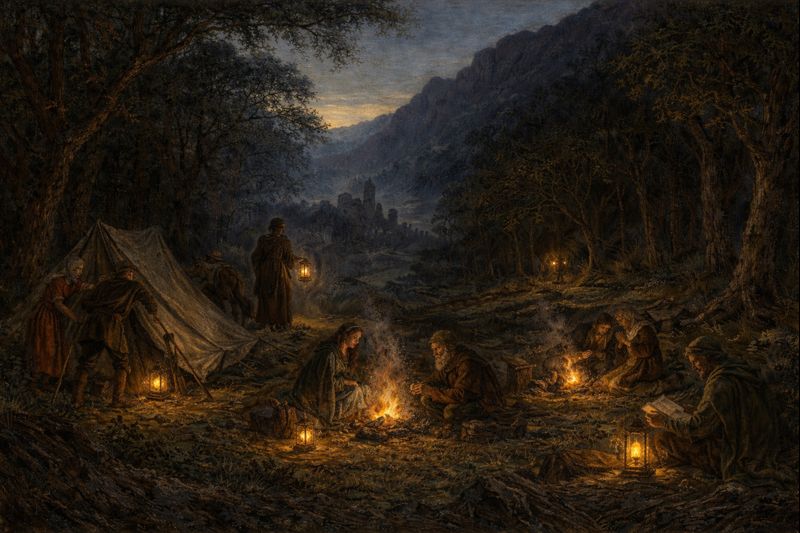
Lately I’ve just tried to keep a regular “rule of life,” minimal and simple. Without an international Church organization to rely on, it feels like we’re camping in the woods—operations are primitive. So simplicity seems necessary.
That leads to another issue. We end up loosely associating with international organizations anyway—corporations, governments, even church organizations. I might pray at a local cathedral owned by modernists. Materially it exists; formally it isn’t Catholic. In that sense, something like sedeprivationism seems to describe the lived experience, even if the half-pope theory itself is wrong.
There is no independent “trad republic.” We live in society. It would be helpful if trads talked more about how to act as conscientious dependents. This includes practical questions, like whether to send kids to parochial schools when there is no alternative system.
Related to that, I haven’t seen home-aloners set up even basic things like marriage. If I find someone to marry, what am I supposed to do? Have someone substitute for a priest and say certain words? There’s no minimal Catholic system, so people end up improvising ad hoc.
An alternative might be to accept that people will make mistakes. But trads often act like perfectionists while offering no defined standards. That’s psychologically destructive—being judged by undefined expectations.
Even basic communication standards are missing. Emails like this often turn into accusations of heresy, sins of the tongue, or fault-finding on unclear criteria.
There’s also no process for resolving disputes—sedevacantism versus sedeprivationism, for example. No serious attempts at mutual resolution or elimination of incorrect positions.
So are we just waiting it out? A decade later, not much has changed. Do we try to make progress, or just wait for God to intervene? My own thought has been that Vatican II must be shown to be non-Catholic and a pope elected in Rome, though I know you think the end-times context makes that unlikely.
Do you have thoughts on what comes next for home-aloner sedevacantism? I’ve imagined a quiet, normal Catholic life adapted to these circumstances: real people, real prayer, basic standards, and some plan for progress.
Let me know if any of this resonates.
Please pray for all in need of prayers.
— Z33K
Reply
Good to hear from you again. I’m glad you wrote, and I recognize the spirit in which this message was sent. Much of what you describe reflects the actual lived condition of serious Catholics right now, not an abstract debate.
CatholicAxis was not a rebrand of CatholicEclipsed so much as a narrowing and a stabilization. CatholicEclipsed was diagnostic. It named collapse. CatholicAxis is architectural. It is concerned with orientation: what can still be known, what must still be held, and how one thinks and acts without pretending the ecclesial situation is normal.
On end times: I do not make calendar predictions. When I speak of the end, I speak theologically and civilizationally, not apocalyptically. The world continuing year after year does not falsify that claim. Late stages persist because they are exhausted, not because they are vigorous. Any position that cannot sustain ordinary moral and spiritual life is defective.
Your “camping in the woods” analogy is apt. Simplicity is not optional. A rule of life must be minimal, durable, and repeatable without specialists. Complexity does not prove seriousness.
You are right that we necessarily live amid institutions that are not Catholic in form while retaining Catholic material elements. The question is not whether this can be avoided—it largely cannot—but how to use such things without self-deception.
Marriage and sacramental questions expose the gravity of the situation. The absence of clergy with mission creates real problems that cannot be solved by denial or improvisation. At the same time, undefined standards and cruelty are indefensible. If standards exist, they must be stated. If they do not, expectations must be adjusted.
Communication has collapsed because accusation has replaced argument. There is little principled dispute resolution. This is one reason CatholicAxis exists: to insist on definable claims, intellectual honesty, and accountability to reason rather than personalities.
I do not believe in passivity. Nor do I believe we can engineer restoration by optimism. What can be done now is more modest and more demanding: clear thinking, moral seriousness, local association where possible, and refusal to lie about what exists and what does not.
You are right that a minimal Catholic system has not been articulated well. That does not mean it cannot be—but it must be done without pretending to authority one does not possess.
Your question is not “who is right,” but how one lives truthfully under these conditions without breaking faith or sanity. That question is legitimate. It is also unresolved.
That is the axis CatholicAxis is attempting to hold.
Invitation
CatholicAxis welcomes correspondence of this kind—serious, reasoned, and ordered toward truth rather than faction. Readers with questions, objections, clarifications, or prayer requests are encouraged to write. Where appropriate, such correspondence may be reproduced, with discretion, for the benefit of others navigating the same difficult terrain.
Pray for the Church. Pray for clarity. Pray for perseverance.
