Rome never slept, though she forgot more each year what it meant to remember, and in that forgetting she learned to breathe easily while pressing her weight, untroubled and immense, upon the smaller lives hidden beneath her stones.
Above ground, the city announced herself without shame or hesitation: sandals struck pavement, wheels groaned beneath carts, wine flowed, laughter spilled from doorways, and incense rose freely from public altars where loyalty was measured not by conviction but by compliance. Below ground, however—beneath the marble, the forums, the temples raised to gods who demanded nothing more than gesture—another city endured in silence, carved patiently into earth and darkness, its citizens bound not by convenience but by truth.
It was there, beneath Rome, that I learned what it meant to be Catholic.
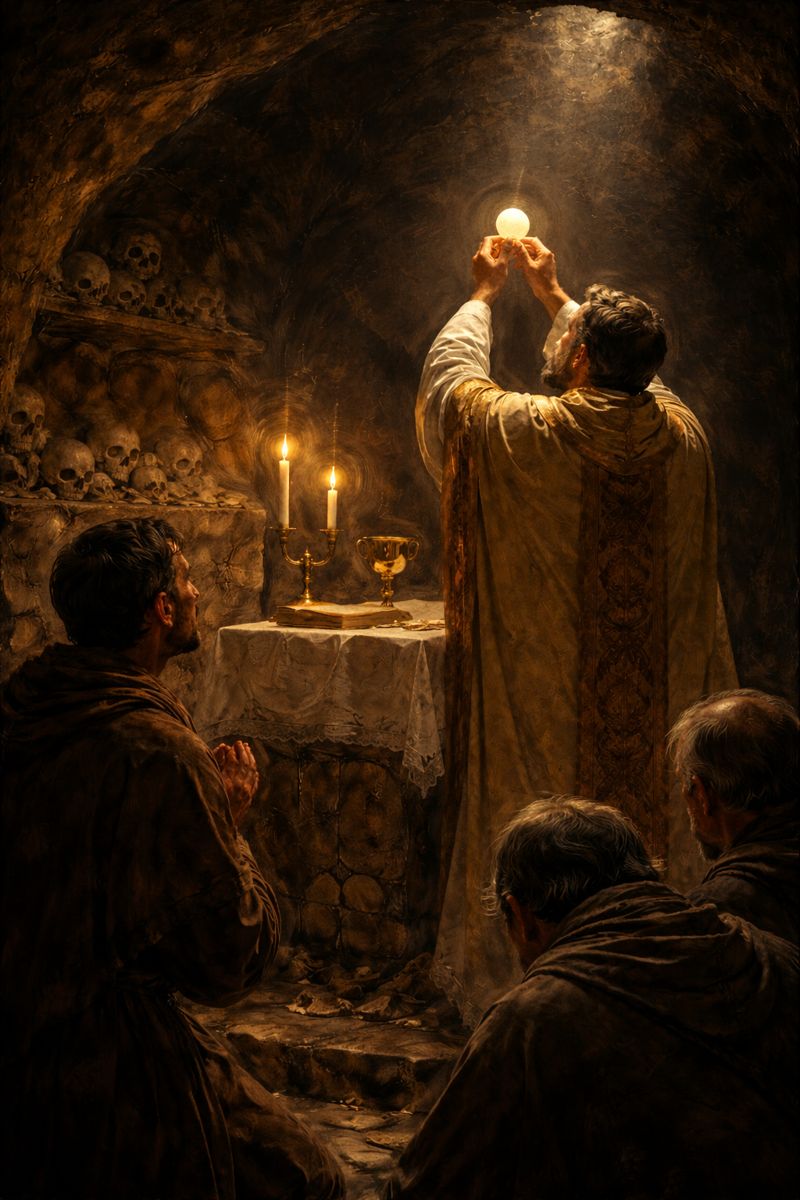
Not as a custom inherited without cost, nor as an idea entertained at leisure, but as a belonging that claimed the whole man and demanded payment in ways the world never counts. We gathered not beneath arches but among bones; not to celebrate ourselves, but to remember Christ; not to be seen, but to remain. The dead lay stacked in narrow shelves, sealed behind rough stone, marked only with signs we dared not display above ground—the fish traced quickly, the anchor scratched shallow, the cross hinted rather than declared—each grave a sermon preached without words.
I descended alone most nights, and though I was never truly without company there, the solitude of my life pressed heavily upon me in those hours when the torchlight faltered and the earth itself seemed to listen.
The Faith That Could Not Be Named
My wife had gone before me into the catacombs, baptized while the fever still clung to her, her confession whispered with a steadiness that astonished me even then, as though she already stood nearer to Heaven than to the room in which she lay. My kin had long since turned from me, their devotion to the gods as effortless as breathing, their patience for my refusal already exhausted. My neighbors smiled with the careful politeness reserved for those who are watched. Rome had room for every god except the one who had conquered death.
Among the faithful below, I felt the nearness of the Church; among the living above, I felt her absence like a wound that no habit could cauterize.
We Catholics were taught caution, but never cowardice, and we learned early that secrecy was not the same as denial. A careless word spoken too loudly, a missed sacrifice observed by the wrong eye, a refusal offered once too often—these were enough. Rome tolerated diversity readily, but not obstinacy, especially when that obstinacy claimed allegiance to a crucified man and named Him Lord. The accusations changed with the years—atheism, impiety, hatred of mankind—but the offense remained the same: we would not worship what was not God.
At the center of it all stood the Eucharist, dangerous precisely because it was ordinary in appearance and extraordinary in truth.
In the catacombs, by torchlight and whispered prayer, the priest spoke the words handed down to him at the cost of others’ blood, and Heaven bent low enough to rest in his hands. I received kneeling, fully aware that this single act—so small, so quiet—placed me outside the protection of the Empire, even as it drew me fully into the life of Christ.
The Watching Eye of Rome
The summons came at dawn, as such things often do, when the world appears gentlest and danger wears the face of order.
A local official—no tyrant, no philosopher, merely diligent—had noticed the pattern of my absences, my reluctance at the public rites, my presence near an entrance long rumored to shelter Christians. Rome, ever efficient, prefers suspicion to certainty; it saves time and blood alike.
I was not accused. I was invited.
That night, sleep did not come. I sat with a single oil lamp and recited the Psalms from memory, lingering over those verses that speak honestly to fear without flattering it, and as I prayed I found my thoughts turning not to escape but to clarity. I remembered the faithful whose names were etched crudely into stone below the city. I remembered the priests already taken. I remembered, too, how little was being asked of me.
A pinch of incense.
No words. No oath. Only the gesture.
The Altar of Easy Survival
The chamber was bright and clean, prepared not for judgment but for convenience, and the statue stood ready beside the altar, its stone features idealized, its authority unquestioned. The censer waited, already warm, its fragrance thick in the air, and the official spoke calmly, almost kindly, as though he wished to spare us both the trouble that fidelity so often brings.
“This need not be difficult,” he said, with the weariness of a man accustomed to compliance. “No confession is required. No renunciation. Only the form.”
I stood alone before the altar, stripped of every comfort faith sometimes borrows from company.
There were no brethren beside me, no priest to steady my resolve, no hymns rising from the earth beneath my feet. There were no catacombs here to remind me that others had already gone before me. There was only the truth I carried alone, and the choice that comes when belief is no longer protected by custom or concealment, but must stand naked before power.
In that moment, I understood the true loneliness of fidelity.
To be Catholic then was not to belong to a visible Church, but to bear a truth without witnesses, to choose Christ without applause, to accept that the world would never understand the exchange being made.
When the Choice Is Finally Named
I thought of Christ before Pilate, standing alone beneath the weight of empire, offered release in exchange for silence, life in exchange for betrayal. I thought of His Body given to me beneath the earth, unseen and unrecorded, yet more real than every statue Rome had ever raised. I thought of the life they offered me, and of the life He had promised.
The official waited.
At last, I stepped back from the altar.
“I cannot,” I said, and nothing more was required.
The guards moved with practiced efficiency. The censer swung. The smoke rose, offered without me, and Rome resumed her breathing as though nothing had occurred. Somewhere above, the city laughed, unaware that another citizen had slipped from her grasp.
As they led me away, fear followed closely, as it always does, sharp and insistent; yet beneath it ran something firmer and quieter, a certainty not of survival but of belonging. I was not alone. I belonged to the Church hidden in the earth, to the saints whose blood had already sanctified this city, and to Christ Himself, who had gone first.
Fidelity had cost me my life.
But it had not cost me the truth.
A Word to Those Who Remain
It is easy to close this account and imagine that such trials belong to another age, when altars were public and the cost of refusal was swift and visible. Do not be misled. The demand has not vanished; it has only learned to speak softly.
You are summoned still—to gestures that appear harmless, to silences called prudence, to concessions that cost nothing at first and everything in the end. There is rarely a crowd when fidelity is tested now, and almost never applause when it is kept.
If you feel alone, it is not because you have strayed. It is often because you have remained.
The Church has always been preserved by Catholics who refused to burn incense, even when the refusal was quiet, costly, and unseen. Remain as they did. Remain Catholic when no one notices, when no one thanks you, when only God sees.
That has always been enough.
