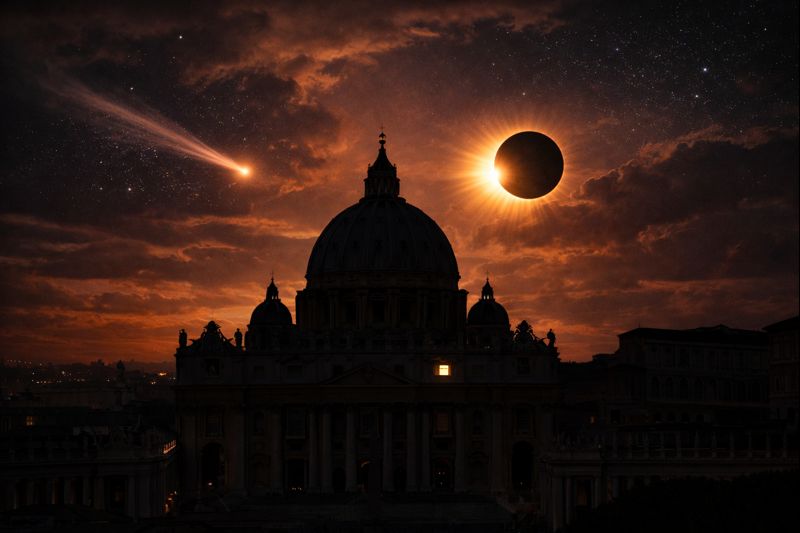
The Church is eclipsed, not destroyed. She exists now as she has always existed: juridical, visible in principle, and bound to reappear recognizably within history unless Our Lord returns first. Any account of the present crisis that denies this is not Catholic, no matter how piously it is phrased.
That is the thesis.
An eclipse does not suspend reality. It suspends visibility. The sun remains the sun even when its light is blocked, and when the shadow passes, nothing new appears. Light simply resumes where it had been obstructed. The Church works the same way. Indefectibility does not guarantee uninterrupted clarity. It guarantees continuity of authority through history, even when authority is gravely impeded in its exercise.
I accept that the Church’s visible juridical hierarchy is not presently identifiable in a reliable way. That acknowledgment does not weaken Catholic doctrine. It presupposes it. But an eclipse that never ends is not an eclipse. It is extinction. And extinction is impossible.
Therefore, restoration is not speculative. It is demanded by what the Church is.
The mistake Home-Alone Catholics must not make
Home-Alone Catholics are not quitters. They are not indifferent. Most arrived at their position through refusal—refusal to accept substitutes, refusal to confuse orders with jurisdiction, refusal to pretend that sincerity can replace authority. Those refusals were correct.
What becomes dangerous is allowing refusal to become permanent posture.
The Church does not disappear into invisibility forever. Catholics are not permitted to treat the absence of authority as a settled condition. Vigilance that no longer expects recognition ceases to be vigilance. It becomes adaptation. History punishes that mistake every time.
I am not interested in urging theatrics—door-knocking, claimant-shopping, or mystical scavenger hunts. That is not vigilance. It is noise. But neither is permanent suspension Catholic.
The Church remains the Church now. Therefore, she remains recognizable in principle now. Therefore, Catholics remain obligated to know what recognition entails.
Authority returns as authority
Authority does not re-enter history gently. It never has.
A restored papacy does not arrive as comfort. It arrives as command. It binds before it reassures. It judges before it explains. It interrupts habits before it heals wounds. That is how authority functions because that is what authority is.
Anyone waiting for restoration to feel affirming will miss it.
As St. Robert Bellarmine taught plainly, the pope is visible because he rules. Visibility follows jurisdiction, not consensus.
The marks of restoration
When the papacy reappears—or when Christ returns and history ends—the difference will be obvious. Until the latter happens, Catholics are bound to recognize the former by objective marks.
Those marks are not negotiable.
Faith.
Public profession of the Catholic faith as always taught, including explicit repudiation of the doctrinal rupture of the past six decades. Continuity is not asserted by tone. It is asserted by correction.
Orders.
Valid episcopal consecration traceable within the Church. No bishop, no pope. This is not romantic. It is Catholic.
Sanity.
The papacy is an office of rule. It presupposes rational capacity and moral seriousness. Grace does not substitute for reason.
Juridical intention.
A claim to the office itself, not a movement, not a parallel structure, not a provisional arrangement. Authority binds. It does not audition.
Anything else is not restoration. It is a substitute.
The Second Coming does not cancel history
Christ may return before the papacy is restored visibly. Catholics have always lived with that expectation. They have never used it as an excuse to stop thinking clearly about authority while history continues.
St. Paul did not permit that confusion in the first century. It is not permitted now.
Catholics desire both: the end of the eclipse and the return of the King. What they do not do is train themselves to recognize neither.
How this answers How to Be Catholic
To become Catholic today is to remain oriented toward the juridical Church even when she is eclipsed. It means refusing false authority without abandoning the expectation of true authority. It means waiting without sentimentalizing the wait. It means understanding what restoration looks like so that recognition remains possible.
Waiting is active when it knows what it is waiting for.
An eclipse ends. Light returns. Authority resumes. Or Christ comes.
Those are the only Catholic options.
